Why Are Americans Spending More on Home Security in 2026 as Burglary Hits a 20-Year Low?
This article was produced with AI assistance. Sources are listed at the end.
Americans are spending more on home security than ever, even as burglary just hit its lowest rate in at least two decades. A November 2026 survey from smart-home company Vivint found that 33% of U.S. homeowners have spent $300 or more on home security in the past five years, and 46% say they're more worried about theft today than they were five years ago. Meanwhile, final 2025 crime data from the FBI show burglary fell 15.8% year over year, pushing the burglary rate to its lowest level in at least 20 years.
That gap between rising spending and falling crime is the real story. Here's what the newest data actually shows, and where a free option — the phone already in your drawer — fits into the budget.
How much are homeowners actually spending on home security in 2026?
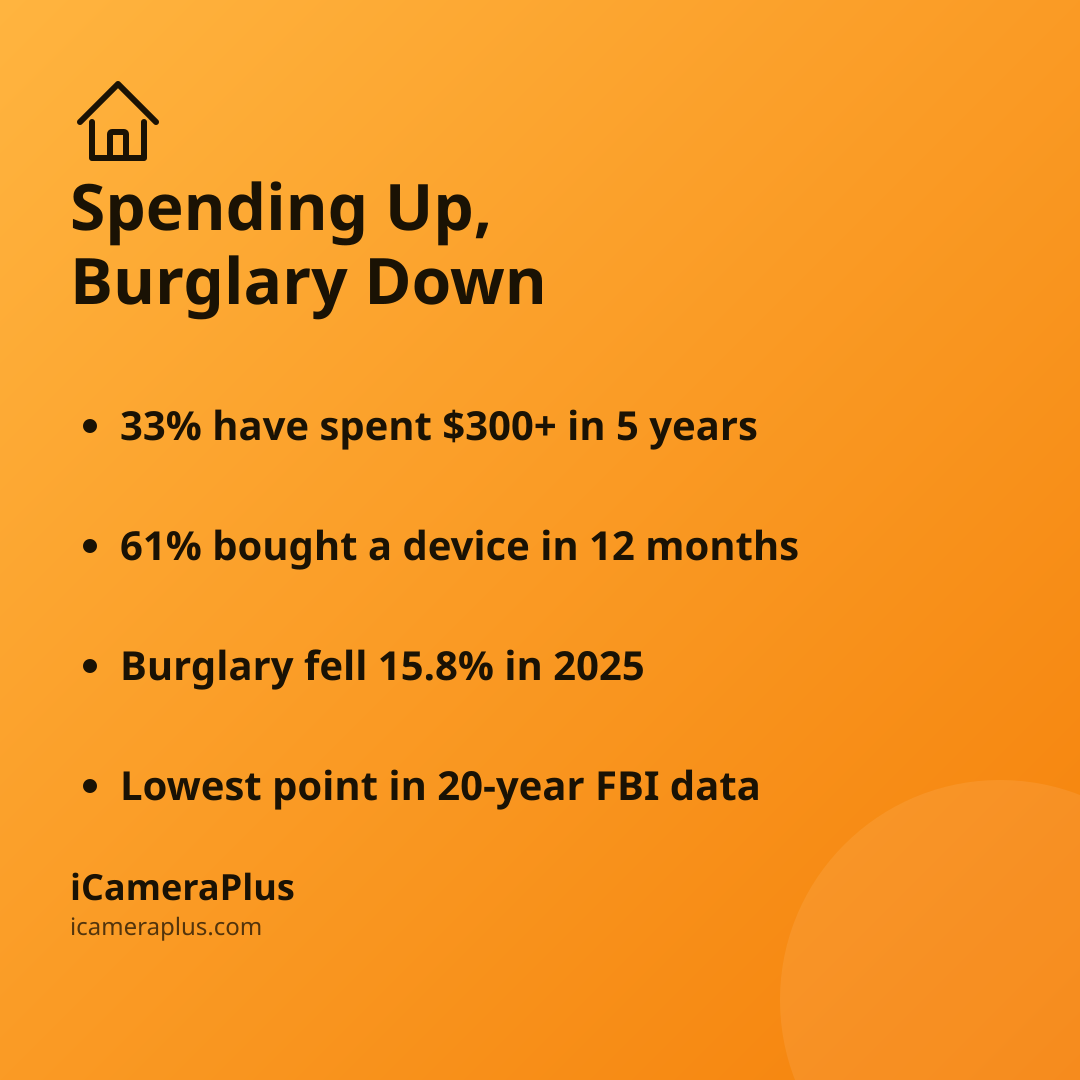
Vivint's second annual "How We Home" report, based on a September 2026 survey of 5,000 U.S. homeowners conducted by OnePoll, found that a third of respondents (33%) have spent $300 or more on home security equipment over the past five years, and 61% bought at least one new smart home device in just the past 12 months. Seventy-eight percent now own at least one smart home device of any kind, according to the same Vivint report.
That spending lines up with a broader adoption trend: SafeHome.org's 2026 Home Security Market Report, published October 16, 2026 from a survey of 2,435 U.S. adults, found that 61% of U.S. households — about 74.9 million homes — now have at least one security camera, up from 52% in 2024 and 42% in 2023, according to SafeHome.org. More households are buying in, and they're paying more to do it.
Why are Americans more worried about break-ins if burglary is actually falling?
This is the part the spending numbers don't explain on their own. The FBI's final 2025 Uniform Crime Report data, compiled from more than 17,000 law enforcement agencies covering roughly 97% of the U.S. population, show burglary declined 15.8% from 2024 to 2025, with the burglary rate reaching its lowest point in the FBI's 20-year reporting series; overall property crime fell 12.4% over the same period, according to the FBI.
Burglary fell 15.8% in 2025 — its lowest rate in at least 20 years, per the FBI.
Yet 46% of homeowners told Vivint they feel more exposed to theft than they did five years ago. Vivint's Managing Director, David Porter, framed the shift this way: "This year's How We Home report illustrates a growing shift in what homeowners expect from a smart home – security, energy management, and intelligent automations working together in a single, simple platform, not a house full of disconnected smart devices," according to the company's press release. In other words, people aren't necessarily reacting to their own neighborhood's crime trend — they're reacting to a general sense that more connected gear equals more protection, and retailers are happy to sell into that feeling, especially heading into the Black Friday and Cyber Monday shopping window.
Does spending more money actually make a home safer?
Not necessarily in a straight line. Security researchers and insurers have long pointed to layered, low-cost basics — locked doors and windows, visible cameras at entry points, good exterior lighting — as doing most of the practical work, with each additional dollar of spending delivering diminishing returns once the obvious gaps are covered. Before adding another $300 line item, it's worth checking what you already own. If you've recently upgraded phones, there's a good chance an old one is sitting in a drawer that could cover one more angle of your home for nothing but a mount and a power cord — a point we've covered in detail in our look at how many old phones are sitting unused in U.S. drawers.
Where does an old phone fit into the home-security budget?
This is exactly the gap apps like iCameraPlus are built for. Instead of buying a new camera to add to that five-year spending total, iCameraPlus turns a phone you already own into a continuously recording security camera, with footage kept in a private cloud archive you can browse from the web, live view when you want to check in, remote start and stop, audio and video, and screen dimming so the phone isn't a bright rectangle in the room — all for monitoring a property you own and control. It won't replace a full system if you need coverage on every side of the house, but it's a genuinely free way to add one more set of eyes before reaching for a credit card.
It's also worth remembering that half-finished setups are common: our research on why 1 in 5 homeowners never finish installing a new smart home device found that buying more gear doesn't automatically translate into more protection if it never gets fully set up. A simpler, already-owned device you'll actually finish installing can beat a fancier one left in its box. For a broader look at what a home camera setup should cover, see our home security camera guide.
- Audit old phones before buying new cameras
- Cover entry points first, extras later
- Compare one-time cost vs. ongoing subscriptions
- Back footage up off-device, not just on it
Quick answers
Is home security spending rising because crime is rising? No. FBI data show burglary and overall property crime both fell sharply in 2025, with the burglary rate reaching a 20-year low, while Vivint's 2026 survey found spending and worry both climbing — the two trends are moving in opposite directions.
How much should I expect to spend on home security? There's no fixed number — a third of homeowners report spending $300 or more over five years per Vivint's 2026 survey, but needs vary by home size and layout, and pricing for any specific product or service is set by the retailer, not a universal standard.
Can I add a camera without spending more? Yes — reusing a phone you already own as a security camera (with an app like iCameraPlus) adds coverage without adding to your security budget, which is worth doing before buying new hardware.