Should You Share Your Security Camera Footage With Neighbors? What 2026 Research Says
This article was produced with AI assistance. Sources are listed at the end.
Yes, it's generally legal to share your security camera footage with neighbors through apps like Ring's Neighbors or Nextdoor, and many people do it after a package theft or a prowler sighting. But 2026 research on neighborhood video-sharing found that the person in the clip matters more than the behavior itself — bystanders and delivery workers get flagged as "suspicious" far more often than neighbors doing the identical thing. That bias concern is serious enough that Ann Arbor, Michigan, removed all roughly 600 of its Neighborhood Watch signs by April 2026, and other U.S. cities are reconsidering similar programs for the same reason.
That doesn't mean you shouldn't share footage. It means the how and who you share it with matters as much as the decision to share at all.
What Are Ring Neighbors and Nextdoor, Exactly?
Neighbors is Ring's companion app for posting text updates, photos, and video from any device to a public community feed tied to your general area. Ring's own support documentation states plainly: "Neighbors is a public space. Your name and exact location will not be shown, but anyone may see your post or comment." Posting is voluntary — your private camera recordings stay under your control unless you actively choose to share a clip, and Ring says users have "full control of who views their video recordings on the Neighbors app," according to Ring's own privacy documentation. Nextdoor works similarly for a defined neighborhood radius, letting residents post about "suspicious" activity, lost pets, or local alerts.
What Does the 2026 Research Say About Sharing Footage With Neighbors?
A peer-reviewed study presented at the 2026 CHI Conference on Human Factors in Computing Systems, titled "Good Fences Make Good Neighbors," surveyed how people judge the acceptability of sharing neighborhood video depending on who appears in it. The researchers found that "outsiders" to the neighborhood — bystanders, delivery drivers, visitors — are treated as more acceptable to record and share than neighbors caught doing the exact same thing, according to the CHI 2026 proceedings. The study also noted that some camera owners admitted to saving footage of bystanders for entertainment rather than any security purpose — a reminder that footage-sharing decisions aren't purely about safety.
Why Are Cities Pulling Down Neighborhood Watch Signs in 2026?
The city of Ann Arbor, Michigan, took down its last remaining Neighborhood Watch sign on April 21, 2026, completing the removal of roughly 600 signs across the city, according to public radio station WEMU. City Council Member Cynthia Harrison said the goal was inclusion, noting "there are people that don't feel welcome," and officials argued the signage didn't meaningfully reduce crime while reinforcing suspicion toward people of color. Journalists at Axios reported in May 2026 that Ann Arbor's move reflects a broader national shift: as apps like Ring Neighbors and Nextdoor take over the informal "watching" that block captains and porch meetings used to do, the same profiling risks that plagued old-school watch programs haven't gone away — they've just moved into an app.
The neighborhood watch didn't disappear in 2026 — it just became an app.
What Are the Real Privacy and Bias Risks?
The American Civil Liberties Union has raised concerns specifically about apps like Neighbors, warning that they can enable racial profiling when users circulate footage of people they've labeled "suspicious" based on assumptions about who belongs in a neighborhood, per the ACLU's published guidance. Combined with the CHI 2026 findings above, the pattern is consistent: the camera itself is neutral, but decisions about which clips get posted, labeled, and amplified are not.
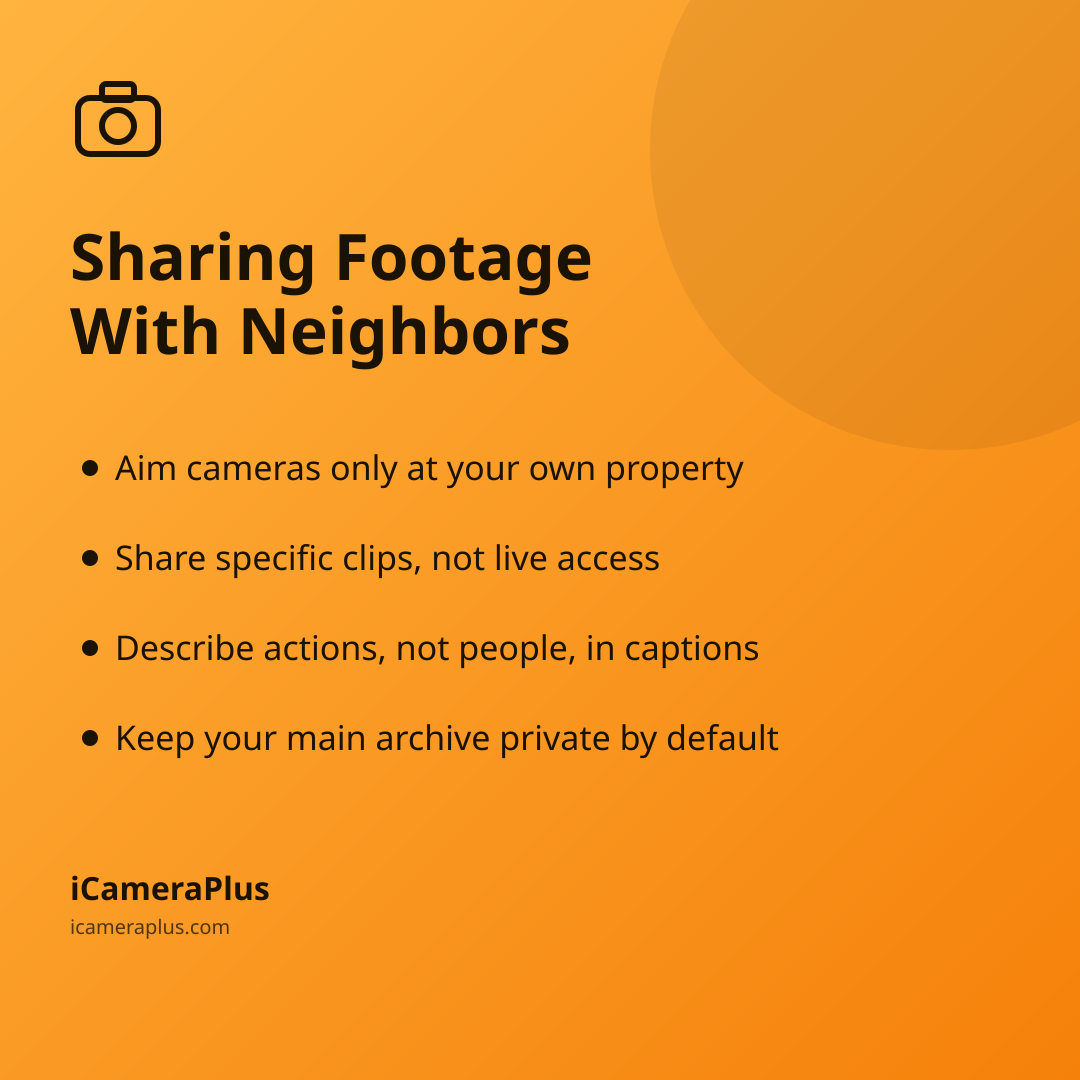
- Aim cameras only at your own property
- Share specific clips, not live access
- Describe actions, not people, in captions
- Keep your main archive private by default
How Should You Actually Share Footage, If You Do?
If a real incident happens — a break-in attempt, vandalism, a hit-and-run — sharing a clip with neighbors or police can genuinely help. The safer approach is to treat your camera's footage as private by default and export only the specific clip relevant to the specific incident, rather than granting a public app ongoing access or posting anything with a subjective label attached. This is one advantage of keeping your own footage in an archive you fully control: iCameraPlus turns a phone you already own into a 24/7 security camera, recording continuously to a private cloud archive that only you can browse from the web panel, so you decide if and when a clip ever leaves your own account. Before you share anything publicly, it's also worth reviewing who else can already reach your footage — see our guide on locking down access to the camera watching your home.
Local laws on recording and sharing footage vary by state and municipality, particularly around audio and areas with an expectation of privacy, so check your local law before recording anything beyond your own property line. iCameraPlus's privacy approach keeps that choice with the homeowner rather than a public feed.
Quick Answers
Is it legal to share my security camera footage with neighbors?
Generally yes in the U.S. if the camera is pointed at your own property, but recording laws — especially around audio and shared spaces — vary by state, so check local law before sharing anything beyond your own footage.
Can police get my camera footage without me sharing it?
On apps like Neighbors, sharing is opt-in — you choose what becomes public, per Ring's own documentation. Separately, law enforcement may still request or legally compel footage through other channels, so it's worth knowing your account's sharing settings rather than assuming everything stays private by default.
Does joining a neighborhood camera app actually reduce crime?
The evidence is mixed. Critics of Ann Arbor's Neighborhood Watch program argued it "didn't reduce crime nearly as much as it targeted people of color," according to WEMU's reporting on the sign removal, and the 2026 CHI research suggests bias in who gets flagged is a bigger factor than most users realize.
Sources
- "Good Fences Make Good Neighbors: What's Acceptable (and What's Not) in Neighborhood Video Surveillance," Proceedings of the 2026 CHI Conference on Human Factors in Computing Systems
- WEMU: "City of Ann Arbor takes down its last Neighborhood Watch sign," April 21, 2026
- Axios: "Neighborhood watch programs are fading in the age of Ring and Nextdoor," May 23, 2026
- ACLU: "Should You Buy a Ring Doorbell Camera?"
- Ring: "Neighbors App Privacy and Data"